
EV Hybrid Service/Services
High-voltage battery testing
Before you repair or replace the battery, you need to know exactly what condition its modules are in. We test the battery directly on the car while it works, and tell you whether it is worth repairing, replacing, or whether the problem is actually somewhere else.
When the battery is worth testing
A test makes sense when the electric range has dropped, the hybrid system warning light has come on, fuel consumption has gone up, or you want to be sure before an expensive repair. It is not a simple maintenance charge, but a measurement of every part of the battery.
Little electric driving, the engine runs all the time
The car manages less and less in electric mode and fuel consumption rises with no explanation from the tyres, brakes or your driving. Weak or unbalanced modules are often the cause.
Hybrid system warning light or codes like P0A80 and P0A7F
The code only shows the area of the problem. Testing on the car shows whether the battery is really at fault and how serious the situation is for each module.
Before a repair or a new battery
Without a test, you are guessing between replacing a few modules, a new battery or looking for another cause. The test gives you the basis for a fair quote.
The battery fan runs often and loudly
When the battery gets too hot, the fan tries to keep up. The test shows whether the battery has worn or whether the cooling is simply clogged.
Why we test the battery on the car before any decision
The dashboard gauge and a quick code read don’t tell you how much life the modules have left. Testing on the car shows the imbalance between them, their capacity and how they behave under load, which is exactly the data you need to choose between repair and replacement.
You decide on concrete data
You see whether only a few modules need replacing, the whole battery, or whether the problem is elsewhere. You don’t pay for a repair just hoping it will work.
Tested on the car, where it matters
The battery works together with the inverter, the cooling and the sensors. On the car you see how it behaves in real conditions, which a bench test doesn’t always show.
A result you can act on
You get a clear conclusion: the battery is in good condition, can be repaired or needs replacing. The next step starts from that result.
How we test the battery
Everything is designed to help you decide: we read the codes, measure the battery on the car, set the results against the symptoms and tell you what comes next.
1. You tell us the car’s history
The symptoms, the mileage, what has been tried so far and whether you have an earlier test. From that we decide what to measure first on your model.
2. We read the codes and the battery data
We read the fault codes, the voltage of each module block, the temperatures and the condition reported by the battery control unit. We separate what happened in the past from the battery’s state today.
3. We test the battery under load
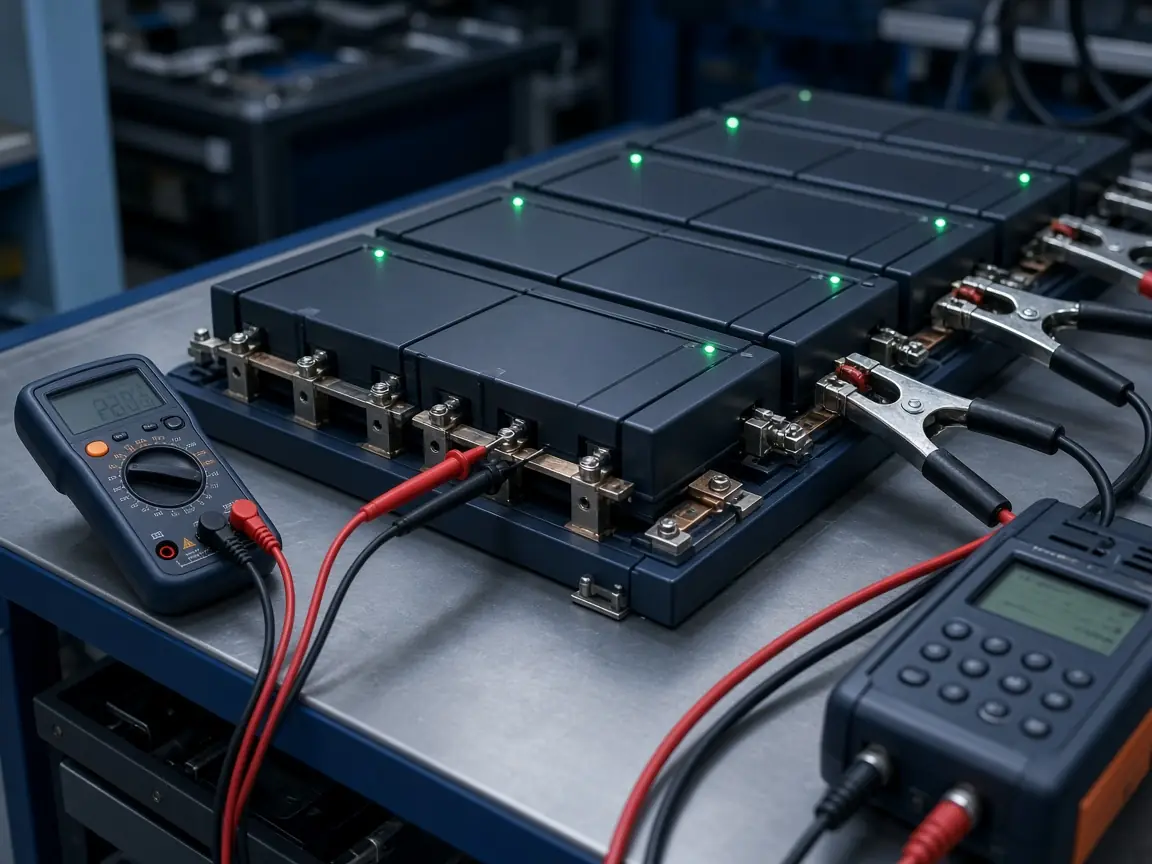
We charge and discharge the battery in a controlled way, directly on the car, and watch every block. A weak module gives way first and stands out straight away.
4. We check the cooling and the systems around it
We look at whether the cooling, wiring or sensors could explain the symptom. Sometimes the battery is the victim of poor cooling, not the cause of the problem.
5. We give you the result and the next step
We explain what we measured and which option makes sense: replacing some modules, a new battery, cleaning the cooling or electrical diagnostics. The quote for the work comes only after that.

What battery testing includes
The test focuses on the condition of the modules, measured directly on the car. What we can read varies from one model to another; we tell you exactly when you book.
- Reading fault codes from the battery-related systems
- The voltage of each block, temperatures and the condition reported by the battery control unit
- A charge and discharge test, watching every block
- Identifying the modules or blocks that give way first
- Checking the connections and the cooling, where accessible
- Working out whether the problem is the battery, the cooling or the electrics
- Written conclusion: in good condition, repairable or due for replacement
- An explanation at the end, without unnecessary jargon
Which makes we test
We test both nickel (NiMH) batteries, used in many hybrids, and the lithium batteries in plug-in hybrids and electric cars. If your model is not listed, ask us and we will tell you whether we can test it.
What the test often shows
We will publish documented jobs one by one. Until then, here are two situations we come across often:
Toyota Prius / Auris
No active codes, but unbalanced modules
The dashboard shows nothing, yet the car drives less and less on electric power. The test finds the weak blocks, which often means only a few modules need replacing, not the whole battery.
Toyota and Lexus hybrids
A battery code caused by a clogged filter
Dust and lint collected in the battery cooling filter and fan make the battery run hot, and the car shows P0A80 or P0A7F. Toyota has acknowledged the problem in official technical bulletins. Sometimes a new filter solves it; if the battery has run hot for a long time, it may already be affected, and the test shows that.
What the test covers and what it doesn’t
The test shows the battery’s condition at the time of measurement. It is not a warranty on the battery and doesn’t replace a repair, but it gives you the technical basis for the next step.
We report what we were able to measure
The conclusion describes what we saw and measured on the car. Some faults can only be confirmed once the battery is removed, and then we suggest that as a separate step.
We tell you up front what we can’t check
If a verdict on every individual module requires removing the battery, we tell you from the start. We don’t give firm verdicts on incomplete data.
What happens after the test
If a repair or replacement is worthwhile, you get a quote based on the results. If the problem is the cooling or the electrics, we point you there, not towards parts you don’t need.
Frequently asked questions about battery testing
Does the battery have to be removed for the test?+
Not necessarily. The standard test is done on the car. If the results call for removing the battery and testing each module individually, we tell you beforehand and separately.
How long does it take?+
It varies from case to case, depending on the model and the symptoms. We give you an estimate when you book.
Do I get a result I can use to choose between repair and replacement?+
Yes. You get a clear conclusion showing what is fine, which modules are weak and what the recommended next step is. The quote for the work comes after the test.
Is it the same as electrical diagnostics?+
No. Electrical diagnostics follow the wiring, sensors and modules around the battery. Battery testing focuses on the condition of the traction battery itself.
Can you test a Prius, Corolla, Kuga, Leaf or Ioniq?+
Yes, most of the common generations. On a Toyota we read the voltage of each module block; on a Nissan Leaf or a Hyundai or Kia we read the state of health reported by the battery control unit and the cell voltages. What data we can get varies from model to model; we confirm when you book.
What if the test shows a repair isn’t worth it?+
We tell you straight. Sometimes replacing the battery is the right answer; other times the cause is the cooling or the electrics. The point of the test is that you don’t spend money on the wrong part.
Find out what condition your battery is in
Book a battery test. We tell you whether a repair, a replacement or something else is worthwhile, before you pay for something you may not need.
Book a battery test