
Battery Repair Volkswagen Multivan (T7, facelift 2026) Plug-in Hybrid 1.5 TSI (245 hp) eHybrid 4MOTION DSG, 25.7 kWh
The Volkswagen Multivan (T7, facelift 2026) 1.5 TSI (245 hp) eHybrid 4MOTION DSG is a plug-in hybrid built from 2026, with 245 hp. Its battery holds 25.7 kWh (19.7 kWh usable).

What we repair
We repair the battery and replace it only when we have to
Most hybrid batteries reach us with a few weak modules, not all of them. And for many of them, the real cause lies in the cooling or the connections.
Module and cell replacement
When only a few modules have weakened, we replace just those, with modules of the same type, tested and matched for capacity and internal resistance. You pay for what has failed, not for a whole battery.
- Every module tested, before and after
- Modules matched to the ones that remain
- Written guarantee on the work
Balancing and reconditioning
An unbalanced battery loses range even when its modules are still sound. We bring every module and cell to the same level, whether the battery is NiMH or Li-ion. On NiMH we run controlled charge and discharge cycles that can recover part of the lost capacity, and on Li-ion we balance the cells one by one, within the safe limits of their chemistry.
- Balancing of the whole battery, NiMH or Li-ion
- NiMH reconditioning, Li-ion cell balancing
- Capacity test at the end
Cooling, BMS and connections
Not every battery fault comes from the modules. A clogged fan, a temperature sensor, a contactor or a corroded bus bar can stop the car just as surely. We check and repair them before we touch the modules.
- Cooling cleaned and repaired
- Sensors, contactors, wiring
- Bus bars and connectors
Battery catalogue
Which battery your car has
215 makes · 1241 models · 5928 versions
Choose the make, model, generation and version. For each version you will find the battery, charging, range and powertrain and, where we have them, the cell chemistry, voltage, European warranty and recalls.
From the workshop
Battery Repair at EV Hybrid Service, See the repairs on our Blog
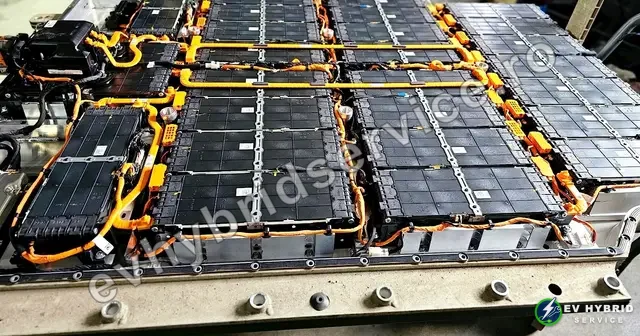 Hyundai Kona Electric losing coolant with no error on the dashboard: how we repaired the cooling circuit of the high-voltage batteryA 2024 Hyundai Kona Electric was losing a lot of fluid from the battery cooling circuit, though the dashboard showed nothing. After a hard impact, a pipe had cracked. We replaced it, sealed the small cracks, and the battery stayed on the car.
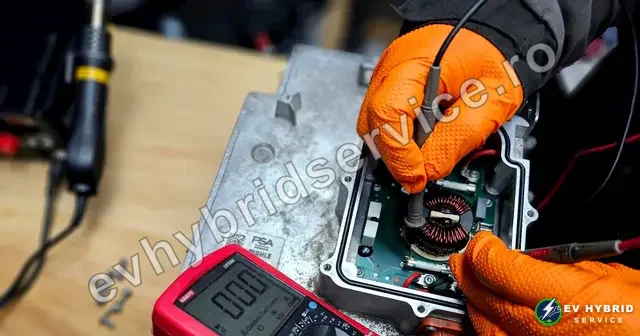 Opel Combo Electric that would no longer charge from a socket: how we repaired the on-board charger without replacing itA 2024 Opel Combo Electric would no longer charge its battery from a socket. The culprit was the on-board charger, where one of the low-voltage electronic supplies had stopped working properly. We repaired it, and the original charger stayed on the car.
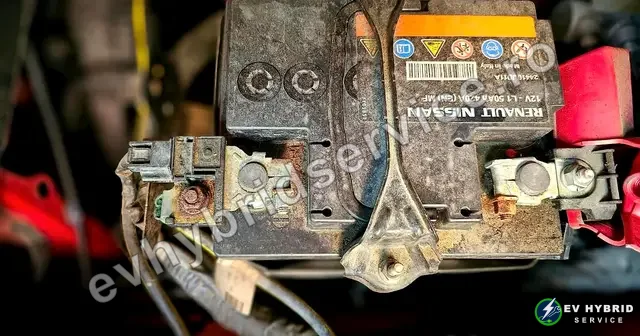 Nissan Leaf 40 kWh with communication errors and insulation faults: how we restored the 12 V supply and repaired the high-voltage insulationA Nissan Leaf 40 kWh had errors in a chain and no longer talked to its climate system. Where it all started: the oxidised terminals of the 12 V battery. Once we restored the supply, diagnosis also turned up high-voltage insulation faults, which we fixed.
Specifications
Volkswagen Multivan (T7, facelift 2026) 1.5 TSI (245 hp) eHybrid 4MOTION DSG
Plug-in Hybrid · 2026+
Battery
25.7kWh
19.7 kWh usable
DC fast charging
40kW
10–80% · 26 min
Battery
- Total capacity
- 25.7 kWh
- Usable capacity
- 19.7 kWh
Charging
- AC three-phase
- 11 kW · 0–100% in 2 h 30 min
- DC (fast)
- 40 kW · 10–80% in 26 min
- Sockets and where they are
- Type 2 AC (Mennekes) (Front right); CCS2 DC (Front right)
Powertrain
- Type
- Plug-in
- Combustion engine
- 1,498 cm³, 177 hp, code EA211evo2/DUCA, Front, Transverse
- Electric motor
- 136 hp, Between the combustion engine and the transmission
- Total power
- 245 hp
- Total torque
- 350 Nm
Range and consumption · Production
- Electric range
- 87–94 km (WLTP)
- Energy consumption
- 15.6–16.1 kWh/100 km (WLTP)
- Years built
- 2026+
EV Hybrid Service
How we repair this battery
A plug-in hybrid battery works harder than a conventional hybrid one: it is discharged deeply on every electric trip and charged from the mains almost every day.
Diagnosis starts with the BMS data: remaining capacity, voltage differences between cells and temperatures. Not every fault comes from the cells; the on-board charger, contactors, sensors and cooling can cause the same symptoms, and those we repair. Module replacement depends on the model and on the parts available.
Photos: Volkswagen Multivan (T7, facelift 2026)
Freely licensed photos from Wikimedia Commons; the author and licence are given for each image.
- 1. Volkswagen Multivan (T7, facelift 2026) · Photo: Retired electrician, CC0
Questions about the Volkswagen Multivan (T7, facelift 2026) battery
How big is the battery of the Volkswagen Multivan (T7, facelift 2026) 1.5 TSI (245 hp) eHybrid 4MOTION DSG?
The battery holds 25.7 kWh, of which 19.7 kWh is usable. How much of that capacity is left on a used car can only be known by testing it.
How fast does the Volkswagen Multivan (T7, facelift 2026) 1.5 TSI (245 hp) eHybrid 4MOTION DSG charge?
It accepts DC fast charging at up to 40 kW (10–80% in about 26 minutes); AC charging at up to 11 kW (0–100% in about 150 minutes). Actual times depend on the charger, the battery temperature and its state of health.
Can the battery of the Volkswagen Multivan (T7, facelift 2026) 1.5 TSI (245 hp) eHybrid 4MOTION DSG be repaired?
Often, yes: a battery rarely fails all at once; usually a few modules or cells weaken first, or the fault is in the cooling, sensors or contactors. We test it first and tell you whether a repair makes sense, before anything is taken apart.
Find out whether your battery is worth repairing
Book a test. We will tell you whether a repair, a replacement or something else is the right call, before you spend money on the wrong part.