
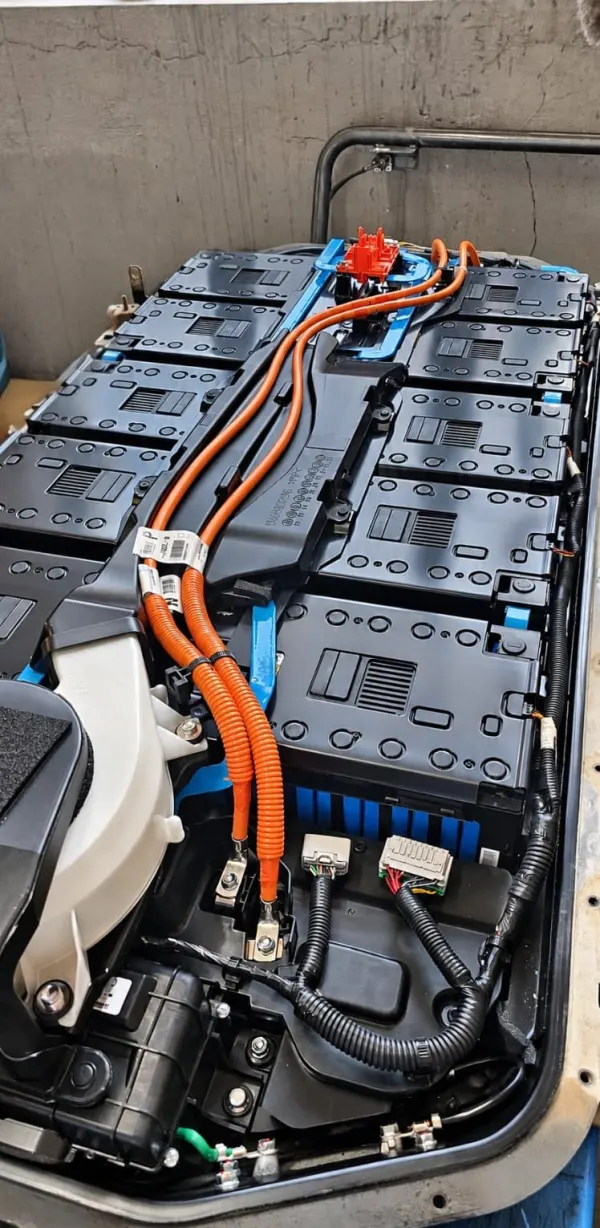
Hybrid · plug-in · electric
Battery Repair: Hybrid, Plug-in Hybrid and EV (electric car)
A fault on the high-voltage battery does not automatically mean a new battery. We test every module, find out what has failed and repair the battery where a repair makes sense. Below you will find your car’s battery, the warranty its maker gives it in Europe, and the work we have done on similar models.
What we repair
We repair the battery and replace it only when we have to
Most hybrid batteries reach us with a few weak modules, not all of them. And for many of them, the real cause lies in the cooling or the connections.
Module and cell replacement
When only a few modules have weakened, we replace just those, with modules of the same type, tested and matched for capacity and internal resistance. You pay for what has failed, not for a whole battery.
- Every module tested, before and after
- Modules matched to the ones that remain
- Written guarantee on the work
Balancing and reconditioning
An unbalanced battery loses range even when its modules are still sound. We bring every module and cell to the same level, whether the battery is NiMH or Li-ion. On NiMH we run controlled charge and discharge cycles that can recover part of the lost capacity, and on Li-ion we balance the cells one by one, within the safe limits of their chemistry.
- Balancing of the whole battery, NiMH or Li-ion
- NiMH reconditioning, Li-ion cell balancing
- Capacity test at the end
Cooling, BMS and connections
Not every battery fault comes from the modules. A clogged fan, a temperature sensor, a contactor or a corroded bus bar can stop the car just as surely. We check and repair them before we touch the modules.
- Cooling cleaned and repaired
- Sensors, contactors, wiring
- Bus bars and connectors
Battery catalogue
Which battery your car has
215 makes · 1241 models · 5928 versions
Choose the make, model, generation and version. For each version you will find the battery, charging, range and powertrain and, where we have them, the cell chemistry, voltage, European warranty and recalls.
From the workshop
Battery Repair at EV Hybrid Service, See the repairs on our Blog
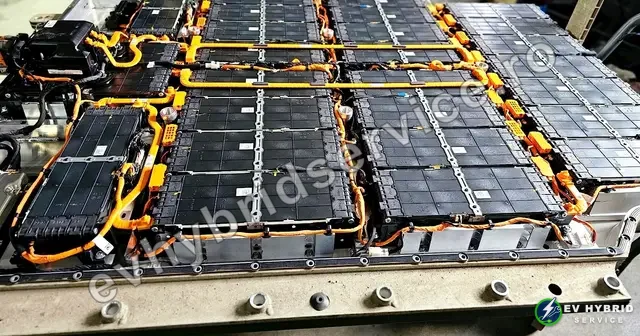 Hyundai Kona Electric losing coolant with no error on the dashboard: how we repaired the cooling circuit of the high-voltage batteryA 2024 Hyundai Kona Electric was losing a lot of fluid from the battery cooling circuit, though the dashboard showed nothing. After a hard impact, a pipe had cracked. We replaced it, sealed the small cracks, and the battery stayed on the car.
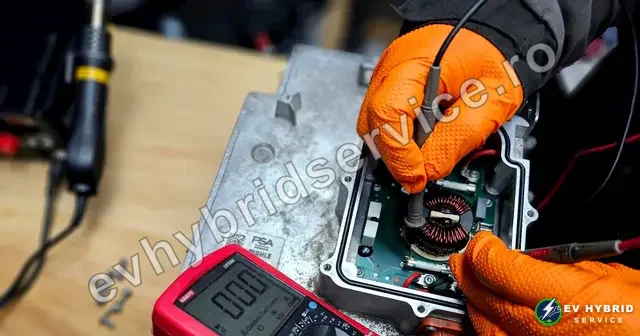 Opel Combo Electric that would no longer charge from a socket: how we repaired the on-board charger without replacing itA 2024 Opel Combo Electric would no longer charge its battery from a socket. The culprit was the on-board charger, where one of the low-voltage electronic supplies had stopped working properly. We repaired it, and the original charger stayed on the car.
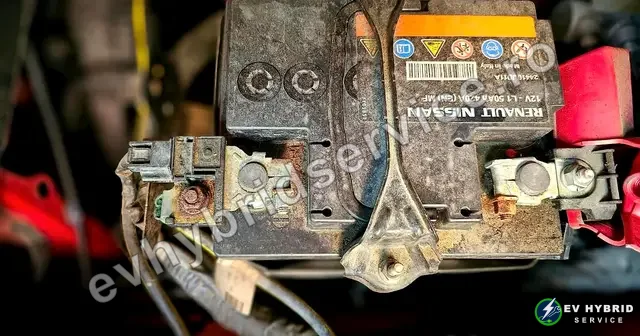 Nissan Leaf 40 kWh with communication errors and insulation faults: how we restored the 12 V supply and repaired the high-voltage insulationA Nissan Leaf 40 kWh had errors in a chain and no longer talked to its climate system. Where it all started: the oxidised terminals of the 12 V battery. Once we restored the supply, diagnosis also turned up high-voltage insulation faults, which we fixed.
Choose your car
Pick the make in the form above, then the model, generation and version, or type the model straight into the search. We will show you your car’s battery and what we can repair on it.
Every make
Every make in the catalogue. Each has its own page, with its electrified models, generations and versions.
- Abarth2 models
- Acura5 models
- Aeolus7 models
- Aion8 models
- Aistaland1 model
- AITO5 models
- Aiways2 models
- Aixam3 models
- Alfa Romeo3 models
- Alpina3 models
- Alpine2 models
- Appollen3 models
- Arcfox11 models
- Aria1 model
- Artega1 model
- Aspark1 model
- Aston Martin2 models
- Audi35 models
- AUDI2 models
- Aurus2 models
- Avatr4 models
- BAIC4 models
- Baojun6 models
- BAW1 model
- Bee Bee1 model
- BelGee1 model
- Bentley4 models
- Bestune6 models
- BMW30 models
- Bordrin1 model
- Bugatti1 model
- Buick7 models
- BYD53 models
- Cadillac8 models
- Caterham1 model
- Cenntro1 model
- ChangAn8 models
- Changan Nevo8 models
- Chery13 models
- Chevrolet13 models
- Chrysler2 models
- Citroen14 models
- Cupra7 models
- Czinger1 model
- Dacia6 models
- Daihatsu1 model
- Deepal9 models
- Delage1 model
- Denza10 models
- DFSK3 models
- Dodge2 models
- DongFeng7 models
- Dorcen1 model
- DR4 models
- Drako1 model
- DS8 models
- e.GO1 model
- EBRO4 models
- Elaris6 models
- EMC1 model
- Enovate2 models
- EVO2 models
- Evolute6 models
- Exeed4 models
- Fangchengbao5 models
- Farizon1 model
- FAW1 model
- Ferrari8 models
- Fiat12 models
- Firefly1 model
- Fisker3 models
- Ford24 models
- Forthing4 models
- Foton1 model
- Freelander1 model
- Fulwin10 models
- Geely19 models
- Genesis5 models
- Geometry5 models
- Gleagle2 models
- GMC3 models
- Haima1 model
- Haval6 models
- HiPhi3 models
- Hispano Suiza1 model
- Honda25 models
- Hongqi8 models
- Hycan4 models
- Hyper3 models
- Hyptec4 models
- Hyundai25 models
- iCAR3 models
- iCAUR2 models
- IM5 models
- Infiniti4 models
- Invicta Electric2 models
- Isdera1 model
- Isuzu1 model
- JAC3 models
- Jaecoo3 models
- Jaguar5 models
- Jeep9 models
- Jetour4 models
- Jiangling1 model
- JMEV6 models
- JY1 model
- Kaiyi3 models
- Karma1 model
- KGM4 models
- Kia27 models
- Koenigsegg2 models
- Lamborghini6 models
- Lancia1 model
- Land Rover7 models
- LDV1 model
- Leapmotor15 models
- Lepas3 models
- LEVC2 models
- Lexus16 models
- Li8 models
- Ligier2 models
- Lincoln4 models
- Linktour1 model
- Livan5 models
- Lordstown1 model
- Lotus3 models
- Lucid2 models
- Luxeed4 models
- Lvchi1 model
- Lynk & Co13 models
- M-Hero3 models
- Maextro1 model
- Mahindra4 models
- Maserati5 models
- Maxus13 models
- Mazda15 models
- McLaren4 models
- Mega1 model
- Mercedes-Benz33 models
- Mercury2 models
- MG23 models
- Micro1 model
- Milan1 model
- Mini3 models
- Mitsubishi7 models
- Moke1 model
- Moskvich1 model
- Munro1 model
- MW Motors1 model
- Neta6 models
- NIO13 models
- Nissan20 models
- Omoda4 models
- Onvo2 models
- Opel9 models
- ORA6 models
- Perodua1 model
- Peugeot12 models
- Pininfarina3 models
- Polestar5 models
- Porsche6 models
- Proton3 models
- Puritalia1 model
- Qiantu1 model
- RAM1 model
- Renault22 models
- Renault Samsung1 model
- Riddara1 model
- Rimac1 model
- Rivian3 models
- Roewe9 models
- Rolls-Royce1 model
- Rox1 model
- SAIC2 models
- Saturn1 model
- Seat3 models
- Seres4 models
- Silence1 model
- Skoda8 models
- Skywell2 models
- Smart6 models
- Sono Motors1 model
- Sony2 models
- Soueast1 model
- Sportequipe1 model
- SsangYong2 models
- Stelato1 model
- Subaru7 models
- Suda1 model
- Suzuki14 models
- SWM1 model
- Tank4 models
- Tata7 models
- Techrules1 model
- Tesla6 models
- Togg2 models
- Toyota49 models
- Trumpchi3 models
- UMO1 model
- Uniti1 model
- Vauxhall6 models
- VinFast7 models
- Volkswagen28 models
- Volvo16 models
- Voyah5 models
- Weltmeister5 models
- WEY14 models
- Xiaomi4 models
- XPENG12 models
- Yangwang3 models
- Zacua2 models
- Zeekr9 models
- Zenvo1 model
- Zhidou3 models
- Zotye2 models
Frequently asked questions about hybrid and EV batteries
Which chemistry do electric car batteries use most often?
The catalogue has 83 electric car batteries. For 48 of them the maker has disclosed the cathode chemistry, and most of those use nickel-based cells: NCM in 28, NCA in 9 and NCMA in 5. LFP (lithium iron phosphate) batteries appear in 5, mostly in newer entry-level versions such as the rear-wheel drive Tesla Model 3 or the Ford Mustang Mach-E Standard Range: they are cheaper, store less energy for the same weight and tolerate frequent charging to 100%. Full hybrids still often use NiMH cells (6 of the 18 hybrid batteries in the catalogue).
What warranty do batteries usually have in Europe?
Most makers give 8 years or 160,000 km and guarantee the battery keeps at least 70% of its capacity: Hyundai, BMW, Volkswagen, Audi, Polestar, Jaguar and Lucid do this, for example, as does Tesla on its rear-wheel drive versions. There are exceptions. The Tesla Model 3 and Model Y Long Range or Performance get 8 years or 192,000 km. Kia offers 7 years or 150,000 km. The Mercedes-Benz EQS and EQE have a 10-year or 250,000 km certificate. Porsche guarantees 80% of capacity for the first 3 years or 60,000 km and 70% until the end. On Toyota hybrids, the factory warranty is 5 years or 100,000 km and can be extended year by year, up to 10 years, through Toyota Hybrid Service. The exact terms are always the ones in the car's warranty booklet.
Why does the same model have different batteries from one year to the next?
Over a model's life, makers change the cell supplier, the chemistry or the capacity. A few examples from the catalogue: the BMW i3 went from 60 Ah cells to 94 Ah and then 120 Ah; the Ford Mustang Mach-E Standard Range switched from NCM to LFP cells in 2023; the Volkswagen ID.4 took cells from LG Energy Solution and later from SK On. That is why the year, the version and sometimes even the VIN matter when you look for a battery part or repair.
Can the catalogue tell me how worn my car's battery is?
No. The catalogue shows which battery the car has and what the warranty promises, not the condition of a particular car. How much capacity a battery has lost can only be found by testing it: reading the battery management system's data and, ideally, measuring the real capacity. As a general guide, studies of large fleets show an average loss of about 2.3% a year in electric cars.
Are these factory batteries or replacements?
They are all the batteries fitted at the factory, as the makers describe them. The data comes from maker documentation, EPA certifications (the US environmental agency), NHTSA recalls (the US road safety authority) and cell supplier announcements. We checked the European warranties separately, in the makers' European documents, and noted the source each time.
Why is the range in the catalogue lower than in European brochures?
The range and consumption in the catalogue come from US EPA tests, which we converted to kilometres and kWh/100 km. The EPA cycle is tougher than the WLTP cycle used in Europe, so the same car usually has a lower EPA range than the WLTP figure in its brochure. For comparing cars, the EPA figures are still useful because they are all measured the same way.
Find out whether your battery is worth repairing
Book a test. We will tell you whether a repair, a replacement or something else is the right call, before you spend money on the wrong part.