
How green is an electric car really? Its environmental impact
What life-cycle studies show, from making the battery to recycling it, and what it means for Romania.
Published · 2 min read
The debate about electric cars and the environment is often argued with facts taken out of context. To compare fairly, you need to look at the whole life cycle: production, use and what happens at the end.
Production: the EV starts at a disadvantage
Making the battery takes a lot of energy, so a new electric car leaves the factory with a larger carbon footprint than a petrol one. The difference is recovered over time, as the car drives with no tailpipe emissions.
Over the whole life cycle
A 2021 study by the independent organisation ICCT compared compact cars registered in Europe. Over their lifetime, an electric car’s greenhouse gas emissions came out 66–69% lower than those of a similar petrol car, including the battery’s production.
Where the electricity comes from matters
How clean an EV is depends on the electricity you charge it with. Romania does well here: in 2024, about 72% of the electricity produced in the country came from low-carbon sources, mainly hydropower (almost 30%), nuclear (around 20%), wind and solar.
The battery at end of life
- A battery that is no longer good enough for driving can get a second life as stationary energy storage.
- Valuable materials (lithium, nickel, cobalt, copper) can be recovered through recycling.
- The EU Battery Regulation, adopted in 2023, sets minimum targets for recovering these materials and for recycled content in new batteries.
And often the battery does not need replacing at all: in hybrids, a battery with a few weak modules can be repaired. We replace only what is faulty and keep the rest, which is better for your wallet and for the environment. See hybrid battery repair.
Other differences
- Brake dust drops sharply, because regenerative braking does most of the work.
- Tyres may wear a little faster because of the weight and high torque.
- In town, zero tailpipe emissions and less noise directly improve air quality.
Is your hybrid battery showing signs of fatigue? We test it and tell you whether it can be repaired.
Battery testing →Read next
Battery repairs
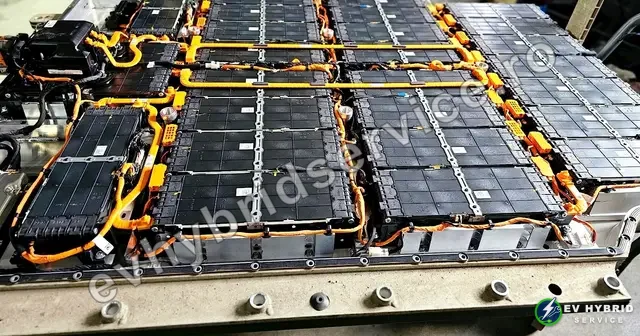
Hyundai Kona Electric losing coolant with no error on the dashboard: how we repaired the cooling circuit of the high-voltage battery
A 2024 Hyundai Kona Electric was losing a lot of fluid from the battery cooling circuit, though the dashboard showed nothing. After a hard impact, a pipe had cracked. We replaced it, sealed the small cracks, and the battery stayed on the car.
3 min read
Battery repairs
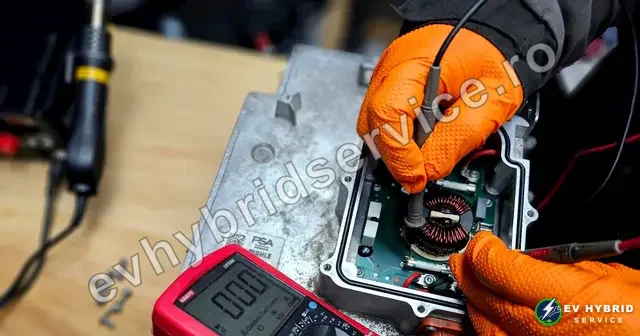
Opel Combo Electric that would no longer charge from a socket: how we repaired the on-board charger without replacing it
A 2024 Opel Combo Electric would no longer charge its battery from a socket. The culprit was the on-board charger, where one of the low-voltage electronic supplies had stopped working properly. We repaired it, and the original charger stayed on the car.
2 min read
Battery repairs
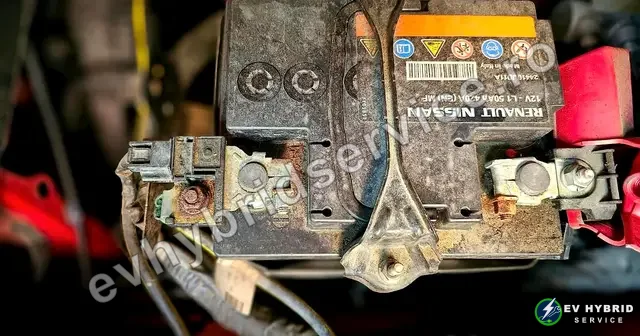
Nissan Leaf 40 kWh with communication errors and insulation faults: how we restored the 12 V supply and repaired the high-voltage insulation
A Nissan Leaf 40 kWh had errors in a chain and no longer talked to its climate system. Where it all started: the oxidised terminals of the 12 V battery. Once we restored the supply, diagnosis also turned up high-voltage insulation faults, which we fixed.
2 min read