
Battery Repair Toyota Prius V (XW60) Plug-in Hybrid 2.0 (223 hp) e-CVT, 13.6 kWh
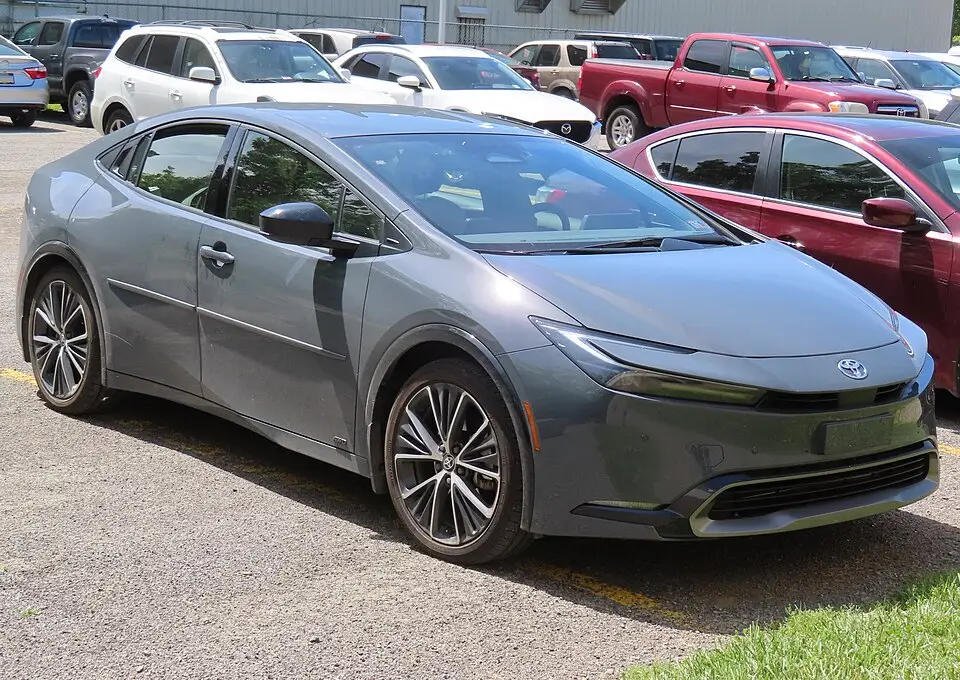
The Toyota Prius V (XW60) 2.0 (223 hp) Plug-in Hybrid e-CVT is a plug-in hybrid built from 2023, with 223 hp. Its battery holds 13.6 kWh, with Lithium-ion (cathode not disclosed) cells. It covers 87 km on electricity.
What we repair
We repair the battery and replace it only when we have to
Most hybrid batteries reach us with a few weak modules, not all of them. And for many of them, the real cause lies in the cooling or the connections.
Module and cell replacement
When only a few modules have weakened, we replace just those, with modules of the same type, tested and matched for capacity and internal resistance. You pay for what has failed, not for a whole battery.
- Every module tested, before and after
- Modules matched to the ones that remain
- Written guarantee on the work
Balancing and reconditioning
An unbalanced battery loses range even when its modules are still sound. We bring every module and cell to the same level, whether the battery is NiMH or Li-ion. On NiMH we run controlled charge and discharge cycles that can recover part of the lost capacity, and on Li-ion we balance the cells one by one, within the safe limits of their chemistry.
- Balancing of the whole battery, NiMH or Li-ion
- NiMH reconditioning, Li-ion cell balancing
- Capacity test at the end
Cooling, BMS and connections
Not every battery fault comes from the modules. A clogged fan, a temperature sensor, a contactor or a corroded bus bar can stop the car just as surely. We check and repair them before we touch the modules.
- Cooling cleaned and repaired
- Sensors, contactors, wiring
- Bus bars and connectors
Battery catalogue
Which battery your car has
215 makes · 1241 models · 5928 versions
Choose the make, model, generation and version. For each version you will find the battery, charging, range and powertrain and, where we have them, the cell chemistry, voltage, European warranty and recalls.
Toyota Prius
Battery Repair at EV Hybrid Service, See the repairs on our Blog
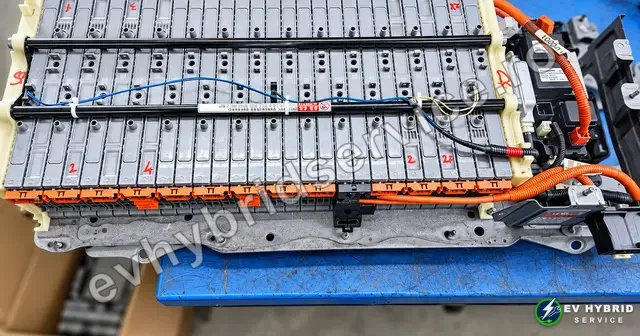 Toyota Prius III with “Replace Hybrid Battery Pack” and no READY: how we repaired the high-voltage battery by replacing 21 modules, and the 12 V batteryA 2014 Prius III came in on a recovery truck, with “Replace Hybrid Battery Pack” on the dash and no longer going READY. It had two problems at once: 21 of the hybrid battery’s 28 modules were worn, and the 12 V battery had fallen to 3 V. We fixed both.
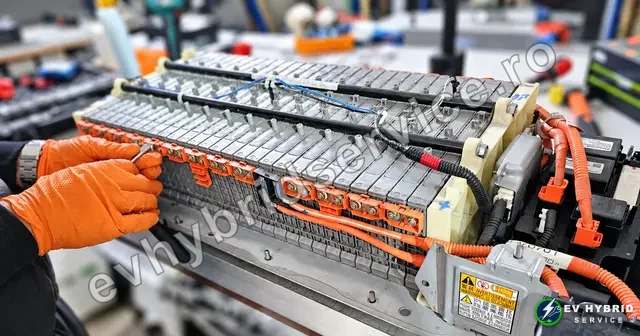 Toyota Prius III with code P0A80 and no READY: how we tested the high-voltage battery and found the real cause, the 12 V batteryA 2012 Prius III came in on a recovery truck, its dash full of warning lights and code P0A80, which calls for a new hybrid battery. The owner was braced for the worst. Yet the hybrid battery was in very good health: the culprit was the small 12 V battery.
Specifications
Toyota Prius V (XW60) 2.0 (223 hp) Plug-in Hybrid e-CVT
Plug-in Hybrid · 2023+ · Li-ion
Battery
13.6kWh
Electric range
87km
WLTC
Total power
223hp
Battery
- Total capacity
- 13.6 kWh
- Cell chemistry
- Lithium-ion (cathode not disclosed)
- Construction
- 13.6 kWh (51 Ah), under the rear seat, 129 kg
Charging
- Sockets and where they are
- Type 2 AC (Mennekes) (Rear right)
Powertrain
- Type
- Plug-in
- Combustion engine
- 1,986 cm³, 151 hp, code M20A-FXS, Front, Transverse
- Electric motor
- 163 hp, 208 Nm, Integrated into the transmission
- Total power
- 223 hp
Range and consumption · Production
- Electric range
- 87 km (WLTC)
- Energy consumption
- 13.4 kWh/100 km (WLTC)
- Years built
- 2023+
EV Hybrid Service
How we repair this battery
A plug-in hybrid battery works harder than a conventional hybrid one: it is discharged deeply on every electric trip and charged from the mains almost every day.
Diagnosis starts with the BMS data: remaining capacity, voltage differences between cells and temperatures. Not every fault comes from the cells; the on-board charger, contactors, sensors and cooling can cause the same symptoms, and those we repair. Module replacement depends on the model and on the parts available.
Battery warranty in Europe
5 years or 100,000 km, whichever comes first
Assumed to match the hybrid terms; no separate official source was found for plug-in hybrids.
Secondary source:toyota.ro
Other versions of the Toyota Prius V (XW60)
Photos: Toyota Prius V (XW60)
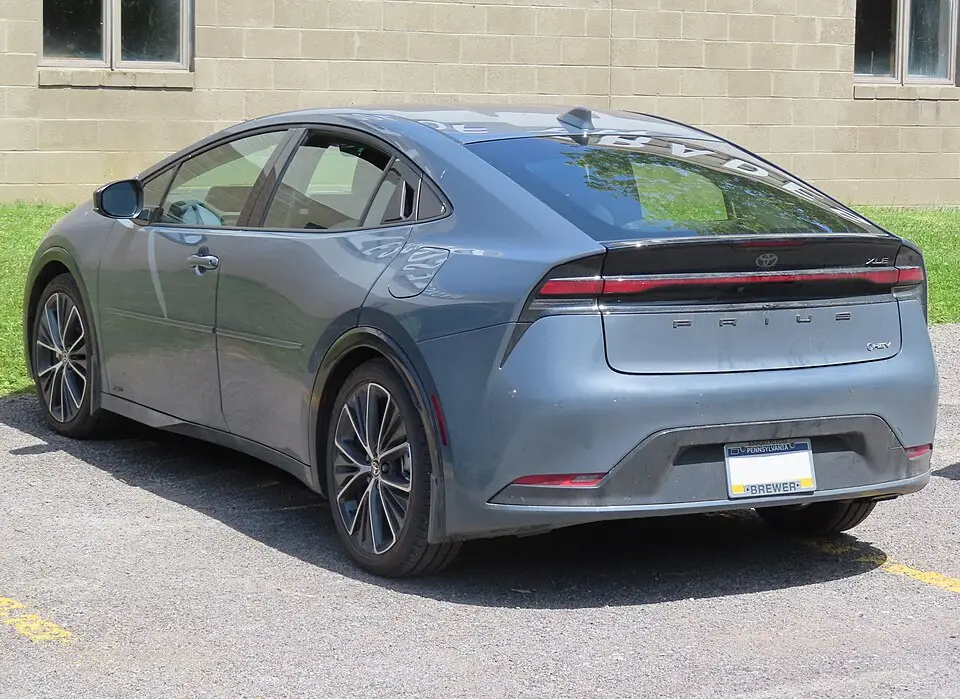
Freely licensed photos from Wikimedia Commons; the author and licence are given for each image.
- 1. Toyota Prius 2023–2025 · Photo: MercurySable99, CC BY-SA 4.0
- 2. Toyota Prius 2023–2025 · Photo: MercurySable99, CC BY-SA 4.0
Questions about the Toyota Prius V (XW60) battery
How big is the battery of the Toyota Prius V (XW60) 2.0 (223 hp) Plug-in Hybrid e-CVT?
The battery holds 13.6 kWh. It uses Lithium-ion (cathode not disclosed) cells. How much of that capacity is left on a used car can only be known by testing it.
How far does the Toyota Prius V (XW60) 2.0 (223 hp) Plug-in Hybrid e-CVT go on electricity?
It covers 87 km on electricity (WLTC cycle). Real range is lower in winter and on the motorway and drops as the battery ages; if yours has dropped noticeably, a battery test shows why.
Can the battery of the Toyota Prius V (XW60) 2.0 (223 hp) Plug-in Hybrid e-CVT be repaired?
Often, yes: a battery rarely fails all at once; usually a few modules or cells weaken first, or the fault is in the cooling, sensors or contactors. We test it first and tell you whether a repair makes sense, before anything is taken apart.
What warranty does the battery have in Europe?
In Europe the battery is covered for 5 years or 100,000 km, whichever comes first. Assumed to match the hybrid terms; no separate official source was found for plug-in hybrids. For Toyota we have not yet found an official document confirming the figures, so treat them as a guide. The exact terms are the ones in your car's warranty booklet.
Find out whether your battery is worth repairing
Book a test. We will tell you whether a repair, a replacement or something else is the right call, before you spend money on the wrong part.